

Essential SEO Corrections for Shopify Stores (With Real Examples)

Shopify is an excellent e-commerce platform. Out of the box, it comes with some basic SEO settings, but not necessarily an ideal SEO configuration. If you want your store to be visible on Google, you need to apply several technical and content corrections. We have applied these in real-world projects, and the results speak for themselves.
1. Correcting Canonicals for Collection Pages
Shopify generates separate canonical tags for each collection page (e.g., ?page=2, ?page=3). This is a debatable practice. It depends on the number of products and where they are linked from. Normally, secondary pages shouldn't be indexed separately, but every case deserves individual analysis.
Real-world example:
At Jatszma.ro, after merging the back office with Jocozaur.ro (uniting two Shopify stores into one), we noticed auto-generated canonicals pointing to paginated pages. We modified the theme so that all paginated pages point back to the main collection page. This significantly reduced the risk of duplicate content. We implemented other settings as well, but in this context, it’s a clear example.
2. Optimizing Meta Titles and Meta Descriptions
Shopify's default formulas are often too generic. In our projects, we manually write titles for products, collections, and static pages.
For projects with specific SEO requirements or for our own site Dalbe.ro — and also at Sweet Mountain — every page and syrup received a custom title and optimized description. At Sweet Mountain, we highlighted ingredients and benefits. In many projects, we observed that after such an update, the CTR in Google increased without using paid ads.
3. Image SEO
Many people forget about images. But they matter — especially for products. Here is what needs to be set correctly:
- Descriptive filenames (e.g.,
ginger-syrup-750ml.jpg) - Real ALT text (not empty or generic)
- WebP format and compression
Real-world example:
At RusticArt, we renamed hundreds of images for solid wood rustic furniture. We added ALT tags, and now we are waiting for the images to appear in Google Images — just as it happened in other SEO projects we've handled (details of which are under NDA).
4. Heading Structure
Each page should have only one H1 tag. Some Shopify themes mistakenly place the logo in an H1 or leave the homepage without one. A poor mix of H1-H6 headings harms the site structure and makes it harder for Google and other bots (including AI bots) to understand the page.
Real-world example:
On the Patentduo.hu site, the homepage had an incorrect mix of headings. We added a clear title focused on "sustainable fashion" in Hungarian (site last verified in May 2025). Google now understands better what the brand offers. We also fixed the heading hierarchy, as we do with every site delivery. Unfortunately, many clients forget this structure when editing content later.
On Dalbe.ro, we double-check that all our articles follow the correct heading order.

5. Clear URL Structure
A product can be accessed via /products/product-name or /collections/xyz/products/product-name. This can lead to duplicate content if not managed correctly.
Real-world example:
On Jatszma.ro, after migrating products from Jocozaur and Jatszma, we set the canonical to always point to the short version. This way, Google no longer indexes the same product twice.
6. Redirects and 404 Pages
Shopify doesn't automatically create a redirect when you delete products. It is essential to set redirects manually. We do this whenever we migrate a webshop. We check the old sitemap and compare it with the new one to ensure the site doesn't lose SEO authority and users don't land on 404 pages.
Real-world example:
In projects like Sweet Mountain, RusticArt, Jocozaur.ro - the board game store, and others, after renaming or moving to a different platform, we created redirects from old URLs to new ones. Thus, no traffic or indexing was lost.
7. Structured Data (JSON-LD Schema)
Shopify offers basic support. But for solid SEO, we extend the default schema provided by the platform:
ProductWebsiteOrganizationArticle(for blogs)
Real-world examples:
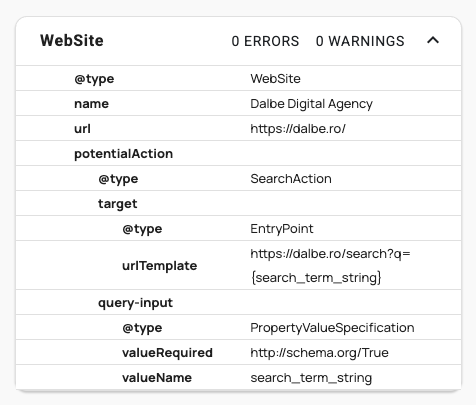
We implemented full JSON-LD schema on:
– Bikeathon.ms, Swimathon.ms, and Bike2School.ro – so Google understands the site structure, business, events, participants, and more. sameAs, for example, is a strong signal for Google in validating a business.
– At Dalbe, we are working on a Shopify plugin that automatically generates JSON-LD where it is missing.
8. Blog and Content
An active blog brings traffic on informational keywords.
Real-world examples:
– On Dalbe.ro, we publish articles about SEO, Shopify, and mobile apps based on real cases.
– On MureșOnBike, blog content includes recommendations for families and tips for cyclists.
We recommend blogs to all our clients, but only if they can maintain them. An authentic and updated blog builds trust and helps potential customers. An uncared-for blog without relevant content can give the impression of an abandoned site with poor UX and non-existent SEO.
9. Multilingual SEO
Shopify Markets allows stores in multiple languages. But it must be configured correctly:
- Full translation of titles and meta descriptions
hreflangtags- Separate URLs for each language
Real-world examples:
– Jatszma.ro and Dalbe.ro have translated content in Romanian, Hungarian, and English, with correctly set hreflang tags.
What we've learned from applied SEO in the last 6 months
- Incorrect canonicals are common but easy to fix.
- Well-named and described images bring traffic from Google Images.
- Custom meta tags improve CTR.
- Correctly translated content brings quality traffic in the right language.
- JSON-LD Schema helps Google better display store or platform data. It can be validated with Schema.org.
- Logical redirects save accumulated SEO authority.
- Blogging works if done well, with purpose and structure.
If you want a real SEO audit based on experience, not theory, write to us.
We don't promise position #1 on Google. But we promise clarity, structure, and applicable solutions. That brings results. Over time, but surely.